KAMMERRAKU SONG - program notes and bios
PROGRAM NOTES
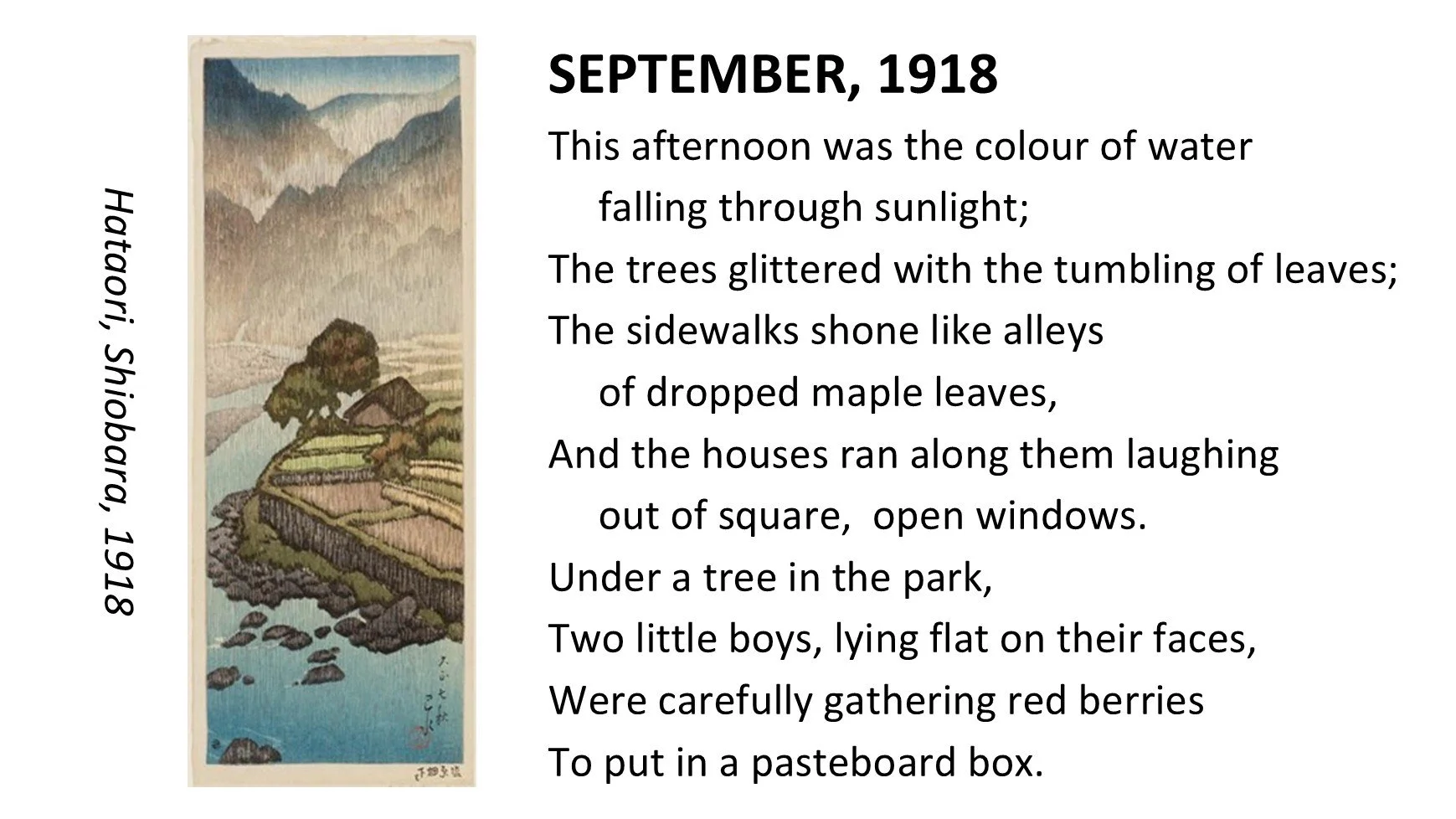
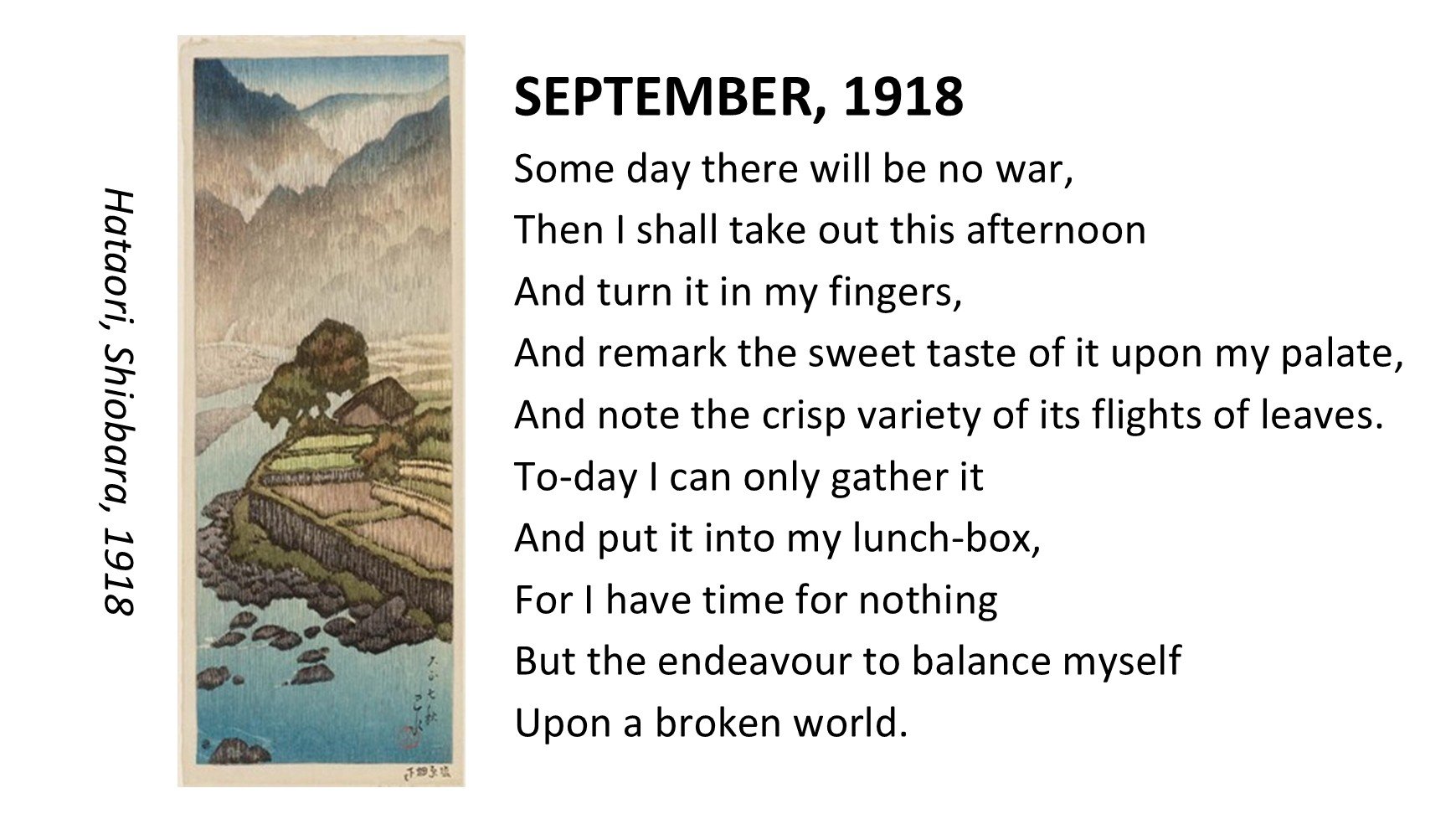
Impressions from the Floating World by Matthew Shorten (2024) a Kyo-Shin-An Arts commission
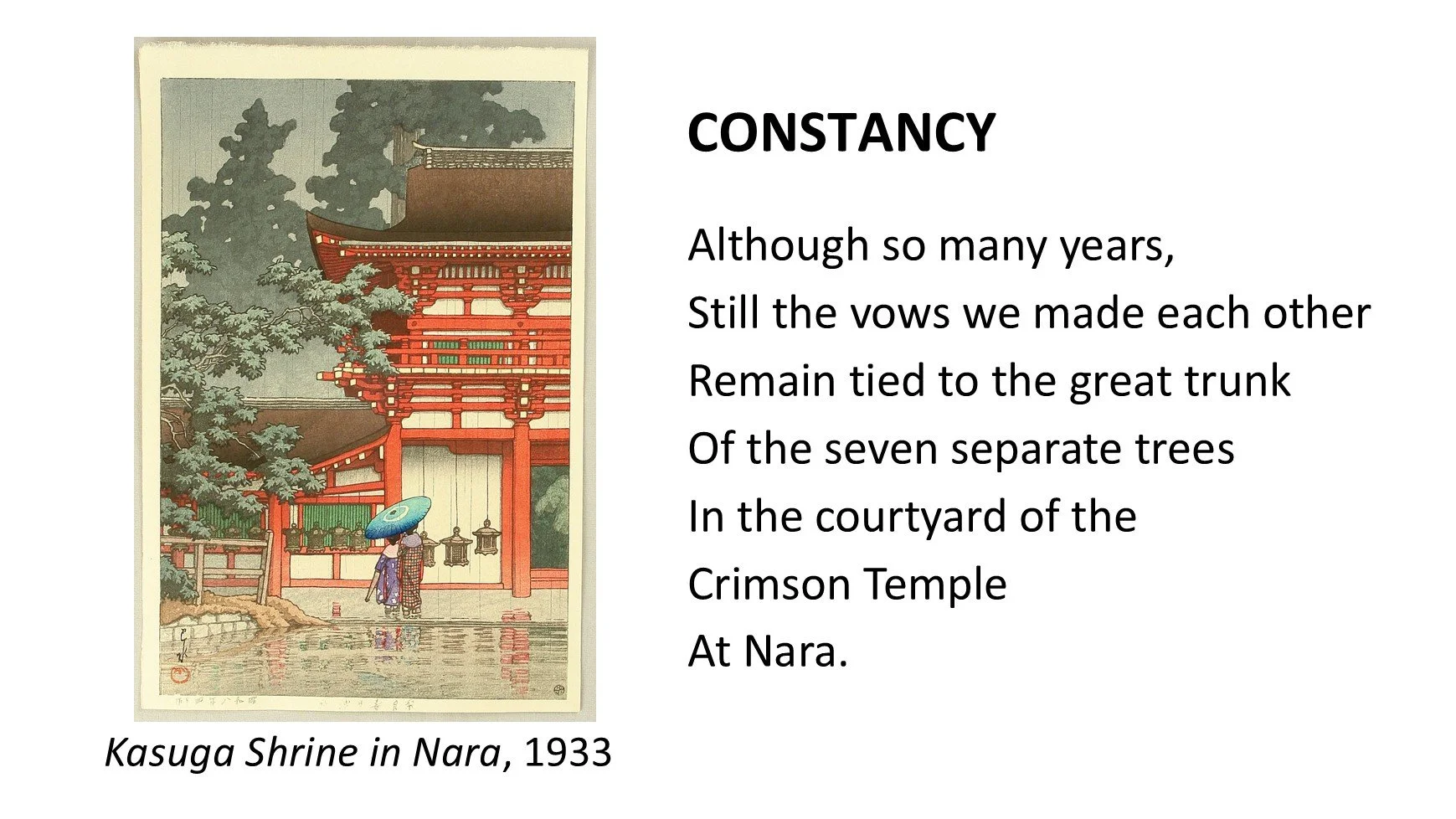
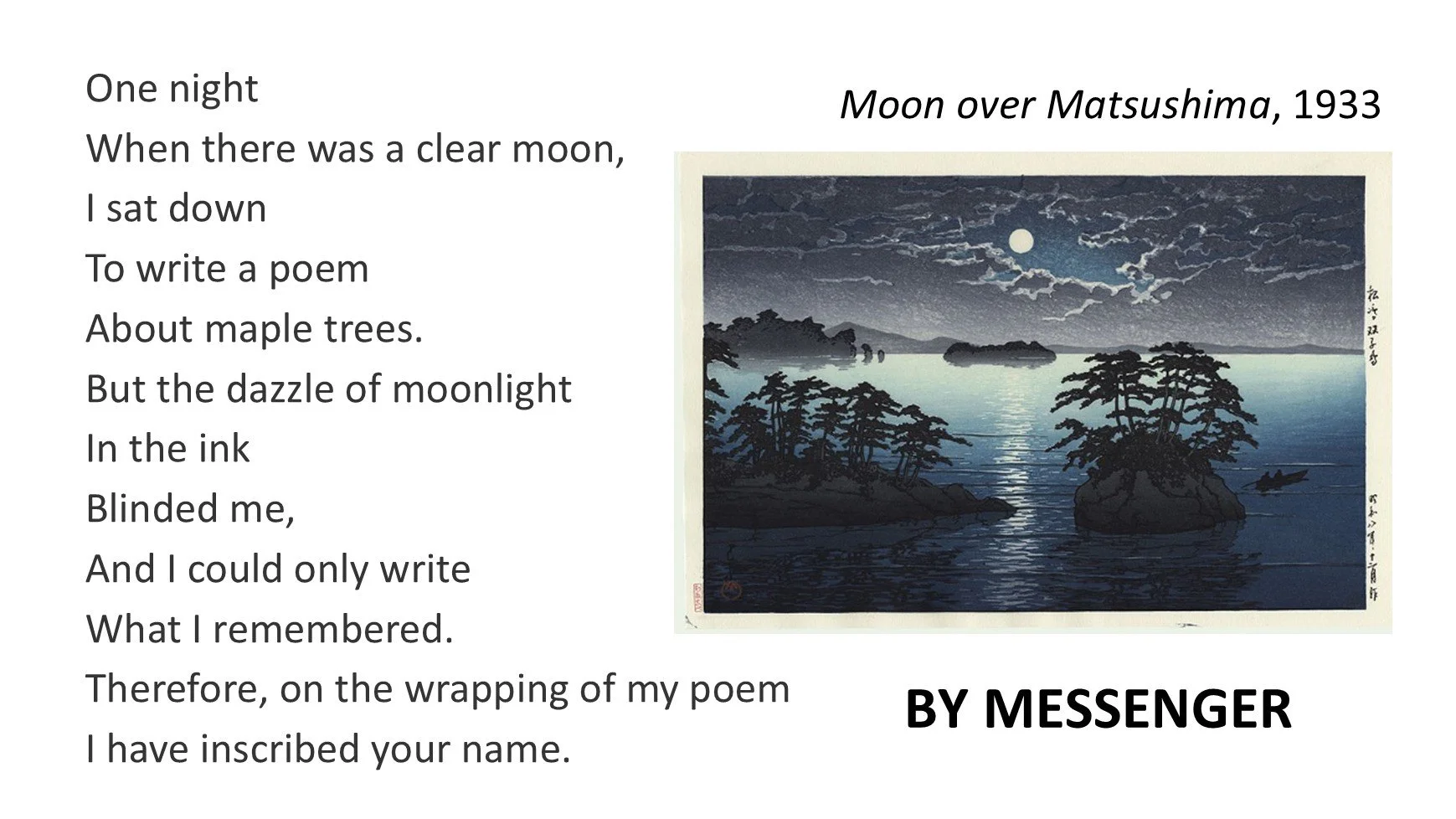
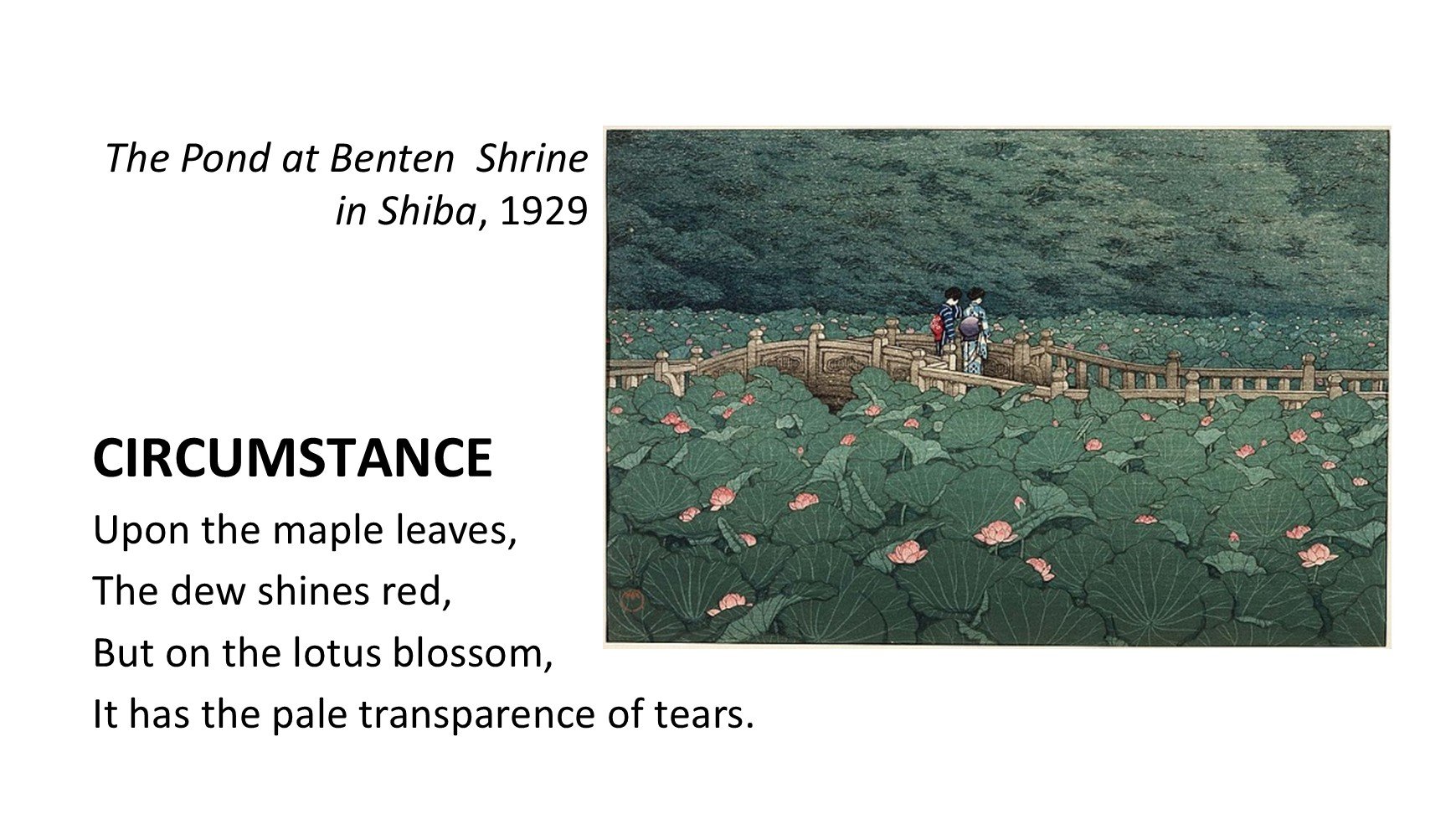
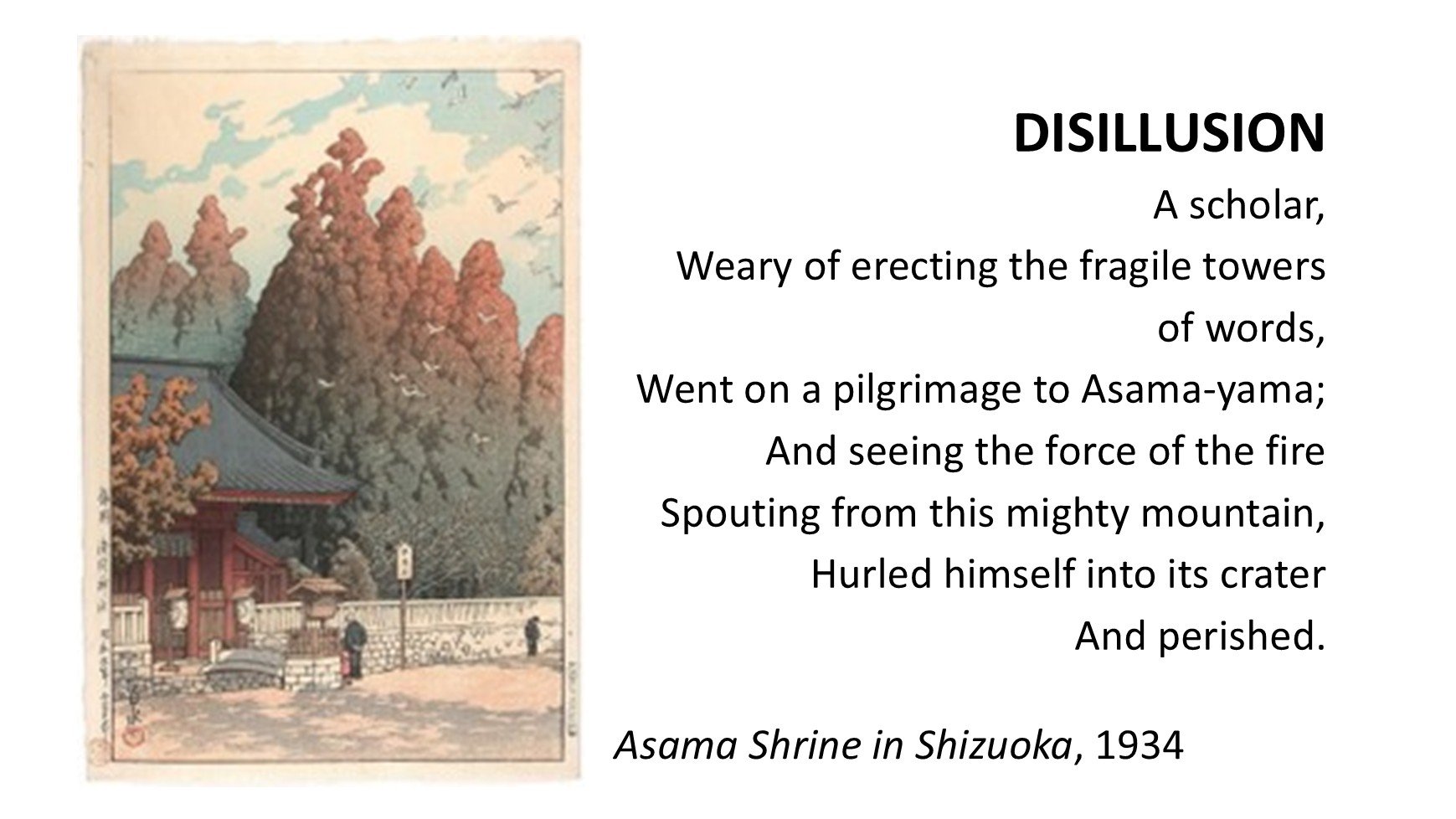
Poems by Amy Lowell - Prints by Kawase Hasui
Please scroll to the bottom of the page for images and poems.
During the Edo Period in Japan (1615-1868), a genre of printmaking emerged known as ukiyo-e, or “pictures of the floating world.” This genre, associated with the aesthetic ephemerality, artistic dynamism, and cultural pleasure-taking of its time, continued into the 19th and 20th centuries. Kawase Hasui (1883-1957) was one of the last masters of this genre, infusing his compositions with principles borrowed from and developed in response to European artists. His works are moving amalgamations of traditional Japan and its transformation in the wake of modernity. Each work bears Hasui’s unmistakable imprint and unique style.
On the other side of the Pacific Ocean in Boston, Massachusetts, Amy Lowell (1874-1925), one of America’s foremost turn-of-the-century poets and cultural figures, was not immune to the crosscurrents of Orientalism and Japonisme that proliferated in her circles. In her poetry collection Lacquer Prints, ensconced in a larger volume fittingly entitled Pictures of the Floating World, Lowell grapples with profound themes of loss, partnership, age, and self-transformation. Some poems are longer, prose-like lessons on the nature of memory and nostalgia, while others are fleeting, momentary breaths of inspiration, mimicking traditional Japanese poetic forms like haiku and waka.
Although I have no evidence that these artists knew each other’s work, I feel that their oeuvres bespeak a shared stylistic and expressive imperative: for East to seek West, and for West to seek East. In my work, Impressions from the Floating World, I have divined this set of miniatures from Hasui’s prints paired with poems by Lowell. My aspiration for each movement was to shine an impossibly bright and distilled light through as small and concentrated a temporal window as possible. To me, these carefully paired prints and poems match so ideally, and so seamlessly, that I can scarcely believe they were conceived and produced in isolation from one another, and by two different people no less. - Matthew Shorten
Home (2019) by Kevin Puts
Commissioned by Orcas Island Chamber Music Festival; Chamber Music Northwest; Chamber Music Society of Detroit; Chamber Music Monterey Bay; Chamber Music Tulsa; Rockport Music
The refugee crisis in Europe, documented in recent media by horrific stories and photos of displaced families, led me to compose Home.
The work begins in what is essentially C Major, or with a tonal center of “C”, which I intended as a sonic representation of "home” and one which is abandoned after the idyllic atmosphere of the work’s first several minutes in search of new and unfamiliar harmonic terrain. As is my way, I worked through the piece in a linear fashion, never certain what lay around each corner. My only hope was that I would find my way back to the musical idea heard at the opening, and that it would present itself in a way that suggested this material (or one’s perception of it) had been altered in some way by the journey the work represents.
I am grateful to Orcas Island Chamber Music Festival and to all co-commissioners for their support of this work. Home is the third work of mine written for the Miró Quartet, and it is dedicated to them with admiration and affection. - Kevin Puts
in place of the blade by Amane Sakaguchi (2026) World Premiere a Kyo-Shin-An Arts commission
“in place of the blade” is based on ““ísumoui’s Lnsí Momcnís,” an episode from Thc Tnlc ofi íhc Hcikc, a Japanese epic written in the late 13th century. I first encountered this story in a high school classical Japanese literature class and was deeply moved by its portrayal of a human being caught between emotion and obligation, rather than heroic triumph or military glory.
Six years ago, I first set this story as a Nngnuín, a traditional Japanese vocal genre accompanied by shnmiscn, a three-stringed lute. Rewriting the original text from The Tale of the Heike into a seven–five syllabic meter, I composed the work entirely within the framework of traditional Japanese music. In this piece, I return to the same source, translating it into English and giving it new musical life through the language of Western classical music.
The music opens with an evocation of the sea at Ichi-no-Tani—waves colliding, surging, and breaking against the shore. This wave imagery recurs throughout the piece, reflecting both the passage of time and the ebb and flow of emotion. The inner states, presence, and dignity of each character are expressed through melody, harmony, and timbre. I sought to differentiate Naozane’s outward composure as a warrior from the turbulence of his inner thoughts.
The narrative unfolds largely from Naozane’s perspective. Atsumori’s inner voice is never revealed; only his spoken words and bearing are presented. The listener is invited to imagine Atsumori’s emotions through Naozane’s gaze. Atsumori’s youthful beauty and refinement are suggested musically through shimmering harmonic textures, like light refracted through a jewel.
The story unfolds during íhc Dníílc ofi IchiLnoLTnni (1184). TniunLno “ísumoui, a young aristocratic warrior of the defeated Tniun (Hcikc) clan, attempts to flee toward the sea, only to be stopped by Kumngni Nnoxnnc, a seasoned warrior of the opposing Gcnji forces. When Atsumori removes his helmet, Naozane is confronted with a youth scarcely older than his own son—remarkably young, beautiful, and marked by an unmistakable dignity. The sight leaves him shaken.
Naozane finds himself unable to strike, drawn into intense inner conflict. Yet his fellow soldiers are closing in from behind. If he delays, another warrior will inevitably kill Atsumori. Faced with this reality, Naozane chooses, in anguish, to take the boy’s life himself and to bear responsibility for Atsumori’s memorial rites for the rest of his life. The episode reveals the harsh truth of the Samurai’s existence: one is often forced to shoulder a destiny wholly detached from personal feeling.
After killing Atsumori, Naozane approaches to wrap the severed head for burial. At that moment, he notices a flute hanging at the youth’s waist. He realizes that this was the very boy whose flute he had once heard sounding from the Heike camp. Even amid bloodshed and destruction, Atsumori had carried not a weapon, but music—retaining elegance, culture, and poetic refinement until the end.
This encounter plants the seed of renunciation within Naozane. The question of why one must endure such suffering simply by being born into the warrior (Samurai) class begins to take hold, eventually leading him toward the decision to abandon worldly life. The text of this work traces the emergence of that inner transformation.
The title “in place of the blade” refers to the quiet revelation that where a sword should have been, there was a flute. It serves as a metaphor for dignity preserved within violence, and for a human presence shaped by grace even in a place devoted to death. I hope listeners will experience this work as one might read a story—allowing its images, emotions, and silences to unfold over time. – Amane Sakaguchi
Bamboo Dances by James Nyoraku Schlefer a Kyo-Shin-An Arts commission
All is not right with the world. There lurks a dark and anxious fear invading our daily reality, and it will not be denied. The dissonances and off-kilter rhythms in Bamboo Dances reflect my sense of this reality in the context of the complacency that cocoons us and allows us to function as usual. Bamboo Dances is loosely based on the form of a Baroque Suite. Each dance-related movement draws from the knowledge I have gathered over 40 years of teaching Classical, Japanese, and World Music. The names have been changed to protect the originals. – James Nyoraku Schlefer
Moveoverture – Get ready to move and shake.
Jubislidy (aka Slickback) – The smooth, gliding feeling of hip-hop dance with an easygoing compound meter that soon becomes unsettled.
Valse Macabre - Grab your partner and waltz the night away while darkness invades with its intoxicating allure.
Chacachacarera – Vaguely reminiscent of the polyrhythmic Argentinian chacarera with its choreography and lyrics that sing of the forced migration of the rural gaucho population.
Bugakuraku – The ancient bugaku dance of the Japanese imperial court rendered quite uncomfortably in this Western classical rendition.
Jiggy Gigue – Ach aye laddie; a palate cleanser before the storm.
Galoopy – A bow to a 19th century galop named for fastest gait of a horse.
Interludy – Leads to…
Racherachenitsa – The Bulgarian rachenitsa is a lively dance with a traditional time signature of 7 beats per measure. In this version, with its frequent meter changes, the Shostakovich-ian darkness can feel overwhelming as it struggles with compassion, love, caring and the light. The light eventually wins out.
PERFORMER BIOGRAPHIES
JULIET SCHLEFER, is a Brooklyn-born, Brooklyn-based lyric soprano singing oratorio, chamber music, opera and art song with repertoire ranging from the baroque to the avant-garde. In 2025 she was a Young Concert Artists semi-finalist, the first-place winner of the Chicago-based Musicians Club of Women competition, and a summer vocal fellow at both the Toronto Summer Music Festival and New Music on the Point. In October she returned to The Washington Chorus as the soprano soloist in Bach’s Magnificat and Reena Esmail’s This Love Between Us following her appearance with the chorus in June 2024 in Buenos Aires’ CCK as the soprano soloist in Mendelssohn’s Elijah alongside acclaimed baritone, Will Liverman. Additional 2025 concerts included appearances with Composers Concordance, Music in the Nave in Kent, CT and Kyo-Shin-An Arts.
Juliet received her 2024 Masters of Music degree from the University of Michigan along with the Earl V. Moore Award for Artistic Achievement. Opera roles at UMich included as Aveline Mortimer in the March 2024 production of Elizabeth Cree by Kevin Puts, directed by Gregory Keller and Kirk Severtson and her Power Center debut in November 2022 as the vixen Bystrouška, in Leoš Janáček’s The Cunning Little Vixen, directed by Tara Faircloth and Kirk Severtson. Juliet also had a leading role in the workshop premiere of Tom Cipullo’s opera, Hobson’s Choice and was cast as Adele in the University of Michigan’s, 2020 production of Die Fledermaus, directed by Grant Preisser. An avid recitalist, Juliet’s extensive collaborative performances have featured a wide body of diverse repertoire with recent highlights including favorite works by Messiaen, Saariaho, Undine Smith-Moore, Cecelia Livingston, Barber, Dvorak, Poulenc, Strauss, Rachmaninoff, Castelnuovo-Tedesco, a lot of new music and plenty in between. julietschlefer.com
JAMES NYORAKU SCHLEFER, shakuhachi and composer, is a Grand Master of the shakuhachi and one of only a handful of non-Japanese artists to have achieved this rank. He received the Dai-Shi-Han (Grand Master) certificate in 2001, and his second Shi-Han certificate in 2008, from the Mujuan Dojo in Kyoto. He has performed at Carnegie Hall, Lincoln Center, the Kennedy Center, Tanglewood and BAM, as well as multiple venues across the country and in Japan, Indonesia, Brazil and Europe. As a composer, Schlefer’s unique style draws upon his deep connections to Western classical and rock music, as well as traditional and modern styles of Japanese music. He has written multiple chamber and orchestral works combining Japanese and Western instruments as well as numerous pieces solely for traditional Japanese instruments. He writes for koto, shamisen, and shakuhachi, with and without Western instruments, combining these instruments with piano trio, string quartet and orchestra. Schlefer has been commissioned by Orchestra of the Swan, Tenri Cultural Institute, the Satori Ensemble, SONOS Chamber Orchestra, Dancing in the Streets, Pearson Widrig Dance Theater and Kyo-Shin-An Arts. His orchestral music can be heard on the recording Spring Sounds Spring Season MSR Classics. He is also a 5-time Hermitage Artist in Residence, Artist. His composition, Bamboo Dances, was begun during his Summer 2024 artist residency at I-Park.
Schlefer has been recognized by Musical America Worldwide as one of their “30 Top Professionals and Key Influencers” for his work both as a composer and Artistic Director of Kyo-Shin-An Arts. His writings about the shakuhachi and his career were published in 2018 on NewMusicBox and he was profiled by the National Endowment for the Arts’ “Arts Works Blog.” His programming as Artistic Director for Kyo-Shin-An Arts has also been recognized with two CMA/ASCAP Awards for Adventurous Programming (2013 and 2016). His orchestral music can be heard on the recording Spring Sounds Spring Season MSR Classics. nyoraku.com
ARIANNA STRING QUARTET: After more than three decades, the Arianna String Quartet has firmly established itself as one of America's finest chamber ensembles. Formed in 1992, the ASQ garnered national attention by winning the Grand Prize in the Fischoff Chamber Music Competition, First Prize in both the Coleman and Carmel Chamber Music Competitions and were Laureates in the Bordeaux International String Quartet Competition. The ASQ has appeared throughout North America, South America, Europe, Asia, and in South Africa. They have collaborated with members of the Vermeer, Tokyo, Cleveland and Juilliard Quartets, and their live performances have been heard on National Public Radio’s “Performance Today,” and “Live from Music Mountain”, which broadcasts to 125 stations in the U.S. and to 35 countries. The ASQ has recorded for Albany Records and Urtext Digital Classics, and extensively with Centaur Records. In addition to their critically acclaimed recording of the two string quartets of Janácek, the ASQ has also recently completed their recordings of the Complete String Quartets of Beethoven. Since 2000, the members of the Arianna String Quartet have been the full-time string faculty at the University of Missouri-St. Louis, where they teach applied violin, viola, and cello, and coach student chamber music ensembles. ariannaquartet.com
COMPOSER BIOGRAHIES
AMANE SAKAGUCHI is a Japanese composer and shamisen player dividing her time between Tokyo and Philadelphia. She completed her bachelor’s degree in shamisen performance at Tokyo University of the Arts in 2021. Currently, she is furthering her studies in composition at the Curtis Institute of Music since 2024.
Growing up in a family deeply rooted in Nagauta (traditional Japanese music), she has been surrounded by this art form from an early age. Her family has maintained the largest Nagauta school in Japan for over 200 years. She listened to her father and grandfather playing shamisen both at home and in Kabuki theaters, which fostered her familiarity with the music. In 2019, she took on the stage name "Kosaburo Kineya," under which she performs professionally as a shamisen player. Her musical education also includes piano, which she began at the age of four. Through her piano studies, she has participated in various competitions, achieving first prize in some. These experiences include performing Chopin's Piano Concerto No. 1 with the George Enescu Philharmonic Orchestra at the Romanian Athenaeum and engaging in chamber music with members of the Czech Philharmonic Orchestra.
MATTHEW SHORTEN - Australian-born composer Matthew Shorten envisions his compositions with an innate expressive sensitivity, ethereal harmonic language, and rich timbral sensibilities. He has received commissions internationally from countless trailblazing organizations, festivals, and concert artists, including VOCES8 & the VOCES8 Foundation, Choir & Organ Magazine, Kyo-Shin-An Arts, chatterbird, the Aster Quartet of the University of Michigan, Anwen Mai Thomas at the Royal Academy of Music, the Cortona Sessions for New Music, the New Haven Symphony Orchestra, Wintergreen Music, and the Blair School of Music at Vanderbilt University, among others. Reflecting the interdisciplinary nature of his compositional inspirations – traversing the bounds of music, art, literature, and the humanities – Matthew’s commissions include his chamber work Ekphrases, a string quartet which brings three cross-cultural portraits to life, and Impressions from the Floating World, divined from poetry by Amy Lowell and Japanese woodblock prints by Kawase Hasui. In 2021-22, Matthew was a Henry Luce Scholar in Asia, forging an array of international artistic partnerships throughout Japan, Singapore, Thailand, and beyond. As part of this cross-disciplinary work at the nexus of composition, performance, and research, Matthew was a Visiting Artist and Guest Conductor with Voices of Singapore, a Visiting Researcher at the Tokyo University of the Arts, and a Guest Artist at the Phuket School of Music. matthewshorten.com
KEVIN PUTS - Pulitzer Prize and Grammy®-winning composer Kevin Puts has established himself as one of America’s leading composers, gaining international acclaim for his “plush, propulsive” music (The New York Times), and described by Opera News as “a master polystylist.” He has been commissioned and performed by leading organizations around the world, including the Metropolitan Opera, Philadelphia Orchestra, Carnegie Hall, Opera Philadelphia, Minnesota Opera, and many more, and has collaborated with world-class artists such as Renée Fleming, Yo-Yo Ma, Yannick Nezet-Seguin, and Marin Alsop, among others.
In March 2022 Puts’ fourth opera, The Hours had its world premiere on the concert stage by the Philadelphia Orchestra under the baton of Yannick Nezet-Seguin, and was hailed as a “historic event ... with a lush orchestration that hits you in the solar plexus." (The Philadelphia Inquirer). The Hours premiered to sold-out houses as a fully staged production at the Metropolitan Opera in November 2022 starring sopranos Renée Fleming, Kelli O’Hara and mezzo-soprano Joyce DiDonato and was called "a stunning triumph" by Variety Magazine. The opera's revival in May 2024 played to packed houses and marked the first instance in the Metropolitan Opera's history of a work returning the season after its premiere. Other highlights of 2022 included the west-coast premiere of The Brightness of Light featuring Renée Fleming and Rod Gilfry with the Los Angeles Opera Orchestra. Written for Time for Three, his triple concerto Contact had its world-premiere in March 2022 with the Florida Orchestra and continues to receive performances around the world. A recording of the piece by the Philadelphia Orchestra and Xian Zhang, conductor was released on the Deutsche Grammophon album "Letters for the Future" and was awarded "Best Contemporary Classical Composition" at the 2023 Grammy® Awards. Mr. Puts was named Musical America's Composer of the Year in 2024.
Puts’ breakthrough opera Silent Night – for which he was awarded the 2012 Pulitzer Prize following its 2011 premiere by Minnesota Opera – has been heralded as “remarkable” (The New York Times) and “stunning” (Twin Cities Examiner). In addition to the Pulitzer Prize, Mr. Puts has received numerous honors and awards for composition. Since 2006, he has been a member of the Composition Faculty at the Peabody Institute and will serve as Distinguished Visiting Composer at the Juilliard School in the 2024-2025 academic year. He returned to his role as Director of the Minnesota Orchestra Composer’s Institute in 2025. kevinputs.com